

Introduction: From Illusion to Anatomy
In recent explorations of stereo imaging, the concept of the “phantom center”—a ghostly voice conjured between two speakers—has been celebrated as a triumph of audio illusion. But what if we could do better? What if we could anchor that center not in the air, but in the listener’s anatomy?
This idea emerged from a cross-platform brainstorm with Gemini AI, where we explored the limits of headphone soundstage. The result was a concept that reimagines headphone design: a third driver, placed on the forehead, transmitting the center channel through bone conduction. It’s not just a technical tweak—it’s a philosophical shift.
The Internal Phantom: Why Headphones Struggle
Traditional headphones, even the best wired ones, often place the sound “inside” the head. Vocals feel disembodied, floating somewhere between the ears. Unlike speakers, which use room acoustics to create depth, headphones lack physical anchoring. The result is a soundstage that feels immersive but not grounded.
Bookshelf speakers rival floorstanders precisely because they sharpen the phantom illusion. But headphones need a new trick. They need a center channel that doesn’t just sound like it’s in front of the listener—it needs to feel like it’s inside them, in a way that’s natural and resonant.
The “Third Driver” Concept
If the lead performer’s microphone is a dedicated source, why are two ear-cups forced to simulate their presence? Imagine a hybrid headphone system:
- Stereo ear-cups handle width, ambiance, and spatial cues.
- A bone-conduction transducer sits against the forehead, dedicated entirely to the center channel.
This tri-sensory approach mirrors studio mixing environments, where the center channel is a physical anchor. By transmitting sound through the frontal bone, the system bypasses the air-conduction bottleneck and delivers resonance directly to the listener’s skull.
Why the Forehead?
Bone conduction is used in hearing aids and niche sports headphones. But placing the transducer on the forehead is a deliberate choice. The frontal bone is broad, stable, and centrally located—an ideal anchor point for the center channel.
Imagine listening to a live performance where the singer’s voice doesn’t just reach the ears—it vibrates through the forehead. The listener isn’t just hearing the music; they’re feeling it. That’s the promise of the Forehead Anchor.
From Phantom to Physical Center
This concept turns the “phantom center” into a “physical center.” It’s no longer a trick of stereo imaging—it’s a dedicated channel with its own driver, its own path, and its own resonance. It’s the difference between watching a hologram and standing in front of a person.
In the context of soundstage design, this idea bridges illusion and reality. It complements discussions on crossover design, stereo imaging, and the emotional impact of anchored sound.
Technical Specs: Splitting the Soundstage
Crossover Design
- Ear-Cups (Stereo Drivers): Handle lateral imaging, ambience, and high-frequency detail.
- Frequency range: ~150 Hz – 20 kHz
- Emphasis on spatial cues, reverberation, and stereo width.
- Forehead Anchor (Bone-Conduction Driver): Dedicated to the center channel.
- Frequency range: ~80 Hz – 1.5 kHz (vocals, snare, bass fundamentals)
- Designed to deliver tactile resonance rather than airy detail.
Signal Routing
- A tri-band crossover splits the audio into three paths:
- Left ear-cup (L channel)
- Right ear-cup (R channel)
- Center channel (summed mono, routed to bone transducer)
- DSP ensures phase alignment, so the forehead anchor integrates seamlessly with stereo cues.
Driver Synchronization
- Latency compensation is critical: bone conduction has different transmission speed compared to air conduction.
- A microcontroller could apply time-domain correction to keep the “felt” center perfectly locked with the “heard” stereo.
Power & Efficiency
- Bone-conduction drivers require more current for tactile resonance.
- Wired mode would maximize fidelity, but hybrid wireless could use dual amplifiers (one optimized for air, one for bone).
The Second Band: A Design Revolution
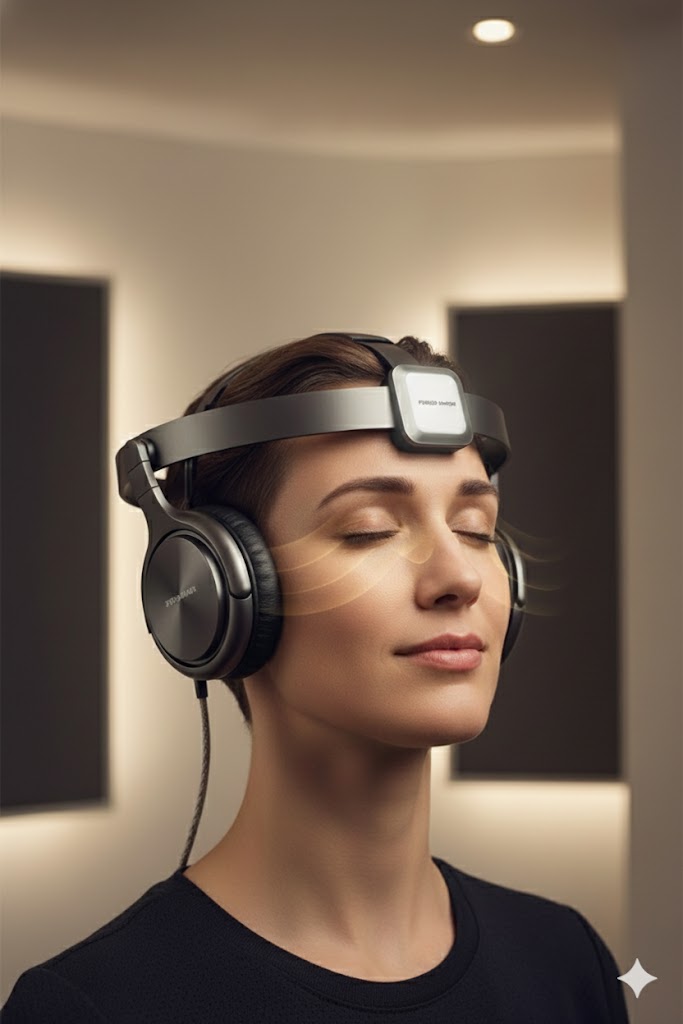
To house the forehead transducer, the system uses a second band that loops fully around the head, intersecting the traditional ear-cup headband. This design ensures stable placement of the bone-conduction driver directly over the forehead, while maintaining ergonomic support for the stereo ear-cups.
This dual-band design opens up new possibilities for modularity. Imagine swapping out the forehead driver for different profiles: vocal-forward, percussion-heavy, or even ASMR-enhanced. The center channel becomes customizable.
Emotional Impact: Anchoring the Performance
The real magic of this concept isn’t just technical—it’s emotional. When the center channel is felt through the forehead, the performance becomes embodied. The singer isn’t floating in the head—they’re resonating through the skull. It’s intimate, immersive, and deeply human.
This aligns with listening experiences where sound envelops the body. The Forehead Anchor takes that idea and gives it hardware.
A New Chapter in Soundstage Design
This concept stands as a keystone in the evolution of soundstage. It builds on earlier explorations of crossover design, stereo imaging, and the illusion of the phantom center, while also complementing advanced speaker architectures such as the KEF Blade with its Single Apparent Source design.
The accompanying schematic, updated with a photorealistic AI-generated featured image, illustrates this tri-driver layout: stereo ear-cups positioned over the ears, and a forehead-mounted bone-conduction transducer held by a secondary band that encircles the head.
Taken together, these ideas invite you to follow a coherent journey—moving from illusion to anchor, from stereo tricks to anatomical truth.
Future Experiments: Prototyping the Concept
Although this design is presented as a concept, it is ready for experimentation. You can explore the idea by prototyping with existing bone‑conduction modules paired with a simple crossover circuit. The purpose is not to achieve flawless execution, but to demonstrate how the phantom center can be transformed into a physical anchor in your listening experience.
If you decide to take on such an experiment, the process itself becomes part of the discovery. By testing how bone conduction integrates with traditional ear‑cups, you gain firsthand insight into the possibilities of a dual‑band headphone system. Even a simple prototype can reveal how sound moves from illusion toward embodiment, offering a glimpse of what future headphone design might achieve.
Closing Thoughts: The Soundstage Reimagined
The Forehead Anchor isn’t just a headphone upgrade—it’s a philosophical shift. It challenges the idea that sound must be simulated. Instead, it proposes that sound can be felt, anchored, and embodied.
In a world obsessed with virtual reality, this concept brings us back to physicality. It’s not about escaping the body—it’s about using it.